15 June 2026
Get Permanent Resident Card in Canada
Learn how to apply for permanent residence and a PR card in Canada after living here under a visa or program. Contact our immigration lawyers for advice.
After living here for sufficient time (depending on the visa obtained in the first place), one can apply for a permanent resident (PR) card in Canada.
You can rely on our Canada immigration law firm for assistance in relocating to this country under the visas or specific programs available.
| Quick Facts | |
|---|---|
| Entry visa requirement (YES/NO) | YES, visa or electronic travel authorization (ETA) |
Types of visas for permanent residency | Work permit or study permit (as a first step), then Express Entry, Provincial Nominee, family or Quebec investor programmes |
Permanent residency by employment availability (YES/NO) | YES |
| Permanent residence through temporary relocation requirements | Canadian Experience Class (at least 1 year of skilled work experience in Canada) |
| Renewal of temporary residence card requirements | Depends on the chosen program |
| Direct permanent residency possibility (YES/NO) | YES, through the Express Entry Scheme, the Provincial Nominee Programs, business and family immigration schemes |
| Living requirements to obtain PR card | None to obtain PR; to keep PR status: at least 730 days in Canada in every 5-year period |
| Permanent residency by investment option (YES/NO) | YES, only through the Quebec Investor Program; the federal investor and Start-up Visa programmes are closed to new applicants |
| Timeframe to obtain PR card (approx.) | Approx. 12 months |
| Relocation with family members possibility (YES/NO) | YES, spouse/partner and dependent children can be included in Express Entry and Provincial Nominee applications |
| Possibility to sponsor family members for immigration (YES/NO) | YES, citizens and permanent residents can sponsor spouses/partners and dependent children; new parent and grandparent sponsorships are paused since 15 July 2026 |
| Citizenship requirements through PR card | At least 1,095 days in Canada in the 5 years before applying (at least 730 as a PR; earlier temporary-resident days count half, max. 365), plus tax filing, CLB 4 language and knowledge test (ages 18-54) |
| Advantages of obtaining a PR card | Access to healthcare and education, possibility to start a business, access to a competitive labor market |
| Support in obtaining permanent residency (YES/NO) | YES |
| Other immigration services | Support in immigrating through various programs, assistance in bringing family members, guidance on becoming a Canadian citizen |
What are the main ways to obtain permanent residency in Canada?
You can apply directly or indirectly for permanent residency in Canada, as follows:
- the direct way implies entering one of the available programs developed by the Federal or Provincial Governments;
- the indirect way implies first obtaining a temporary work or study permit and then meeting the living requirements to become eligible for permanent residency.
What are the programs to obtain a Canada PR visa in 2026?
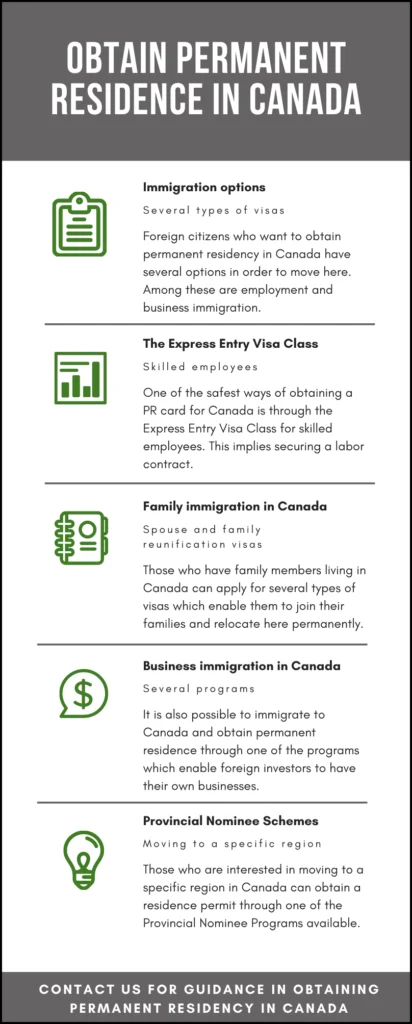
There are 5 programs through which a foreign citizen can acquire a Canada PR card:
- through the Express Entry visa, which is available for skilled immigrants who can occupy vacancies in companies that lack specialized workforce;
- through business immigration programs (mainly provincial and Quebec streams, as the federal Start-up Visa closed to new applications after 31 December 2025) under which entrepreneurs can immigrate to Canada and start their own companies;
- through family class immigration schemes, which are available for immigration to Canada for citizens who have family members living here;
- through the Canadian Experience Class, which enables foreign workers (including former international students) with at least 1 year of skilled work experience in Canada to apply for permanent residence;
- through the Provincial Nominee Schemes, through which foreign citizens nominated by a province or territory can settle there.
Below, you can watch our video on how to obtain a PR card for Canada:
What are the eligibility conditions to qualify for Canadian permanent residency?
In order to determine if one is eligible for a Canadian permanent residence, one can calculate the score in the CRS – Comprehensive Ranking System. Even if this is usually used for Express Entry immigration, it can be used as a model for other schemes.
The applicant must fill out each section in the application, based on which he or she will be provided with the score obtained. For the Federal Skilled Worker Program, a separate 100-point grid applies and the minimum score is 67, while the maximum is 100, as follows:
- the language level can bring a maximum of 28 points;
- work experience can bring up to 15 points;
- education can bring another 25 points;
- through age one can earn up to 12 points;
arranged employment in Canada can bring up to 10 points, and adaptability (e.g., your spouse's language skills or Canadian study/work) up to 10 points.
What program leads to permanent residency in Canada the fastest?
The most important aspect related to obtaining a PR card through a designated program is the processing time of the visa. In this case, timeframes differ not only from one immigration scheme to another, but also from year to year, and even based on the number of applicants.
Our Canadian immigration lawyers recommend not choosing such a program based on the processing times, but on meeting the requirements, as this will ensure the success of your application.
Are there any special programs for French speakers?
Yes, if you are a French speaker, you may definitely increase your chances of obtaining permanent residence through programs like:
- the Francophone Mobility work permit (for jobs outside Quebec), which does not require the Labour Market Impact Assessment;
- the Quebec Skilled Worker Selection Program (PSTQ), as Quebec is Canada's only majority French-speaking province;
- the Express Entry Program, which awards extra points if you have a good level of French.
You can read about the main ways to obtain permanent residency in Canada in the infographic below:
What are the documents required to obtain a PR visa for Canada?
The following:
- the visa application form and proof of payment of the application fee;
- a clean criminal record and medical certificate;
- documents attesting to the reason for immigration (employment offers or contracts, sponsorship letters, etc.) in original and copies;
- proof of settlement funds (a set amount based on family size, required for Federal Skilled Worker and Skilled Trades applicants without a valid job offer);
- the skills and language assessment test results.
Additionally, applicants may be asked to attend an interview with IRCC officials, usually at the Canadian Embassy or Consulate in their home countries.
How long does it take for my Canadian permanent residence card to be issued?
The document is issued quite fast, usually within about 1 to 2 months (IRCC publishes current processing times online).
What happens if I don’t renew a permanent resident card in Canada? Will I lose my status?
No, you will not lose your status, but without a valid card you need a Permanent Resident Travel Document (PRTD) to return to Canada by plane, train, bus or boat.
What are my rights if I become a permanent resident of Canada?
As a permanent resident, you will have various rights similar to those of a Canadian citizen, while holding a different nationality. Specifically:
- you can live, work, and study in Canada;
- you can benefit from social security benefits;
- you can leave and enter Canada based on your permanent residence card.
What are the restrictions that I am subject to as a permanent resident in Canada?
Your permanent residency rights are more limited than those of a Canadian citizen; from this point of view, you cannot:
- vote in federal or provincial elections;
- hold certain jobs for which special clearance is required;
- run for office in political elections.
If you are interested in obtaining a Canada PR visa, please contact our immigration lawyers.